
South African Market Commentary: May 2026
Inflation pressures and bond resilience shape South African markets
South African markets were mixed in May as local equities consolidated and resource shares came under pressure from weaker precious metals prices. Financials and listed property were more resilient, while the market benefited less from the global AI-led rally due to limited exposure to large technology companies. Bonds were the standout local asset class, supported by lower nominal yields, improved global risk sentiment and a pullback in oil prices. Inflation pressures increased as higher fuel and producer costs filtered through the economy, prompting a more cautious SARB stance. The rand strengthened, supported by domestic policy action and broader dollar weakness.
Key highlights:
- Local equities consolidated as weaker precious metals prices weighed on resources, while financials and listed property showed more resilience.
- Bonds stood out as improved global risk sentiment and lower oil prices supported local fixed income.
- Rising fuel and producer costs added to inflation pressure, prompting a more cautious SARB policy stance.
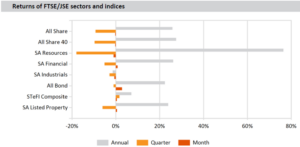
The JSE consolidated in May, with the All Share Index easing 0.3% and the Capped All Share Index down 0.3%. In terms of market capitalisation, Mid Caps fell the most, losing 3.6%, and Large Caps, as measured by the Top 40, slipped 0.2%. Small Caps gained 0.4%. By sector, Financials firmed 0.9%, while Industrials eased 0.7%, and Resources were the weakest segment, down 1.0%. Mining shares remained under pressure as precious metals prices pulled back. Unlike many global peers, the local market has limited exposure to large technology companies and therefore benefited less from the global AI-driven rally.
In terms of individual stock performances, the top performers were Altron, up 32.1% after a strong dividend announcement, Montauk Renewables, up 19.1%, and Bytes Technology, up 18.8%. The heaviest laggards were The SPAR Group, down 24.6% on a profit warning, Sappi, down 23.0% after a quarterly loss, and The Foschini Group, down 18.7% on weak domestic trading.
Bonds were the standout local asset class in May. The ALBI returned 2.9%, comfortably outpacing both inflation-linked bonds and cash. This was due to nominal yields that drifted lower late in the month on improving global risk sentiment and the pullback in oil from its conflict-driven peaks. The rally was notable given the SARB’s 25 basis point hike, suggesting the market viewed the move as credibly anchoring the inflation outlook rather than signalling a prolonged tightening cycle. Inflation-linked bonds, as measured by the CILI, gained 0.6%, lagging nominal bonds as the real-yield segment drew less benefit from the move in the curve. However, they remain the stronger performer year to date at 3.8% compared with the ALBI’s 2.7%. STeFI cash returned 0.5%, reflecting the higher repo rate. Listed property, as measured by the ALPI, advanced 0.7%, supported by firmer financial and property counters even as the broader equity market stayed rangebound.
SA headline consumer inflation accelerated to 4.0% year-on-year in April from 3.1% in March, the highest reading since August 2024, and rose 1.1% month-on-month. Core inflation, which excludes food and fuel, climbed to 3.6% from 3.2%, its highest since November 2024. The main contributors were housing and utilities, up 5.2% and adding 1.2 percentage points, and transport, up 4.9% and adding 0.7 of a point. Insurance and financial services, up 5.7%, added a further 0.6 of a point. The surge was driven by fuel, where prices swung to 11.4% year-on-year from -8.7% in March as the Strait of Hormuz closure lifted Brent crude. The acceleration in core inflation suggests firms are beginning to pass higher operating costs through to consumers, an early sign of second-round effects.
Producer price inflation for final manufactured goods accelerated sharply to 4.8% year-on-year in April from 2.3% in March and rose 3.0% month-on-month. The largest contributor was coke, petroleum, chemical, rubber and plastic products, up 11.8% and adding 2.5 percentage points, as diesel prices surged 33.8% and petrol increased 8.6%. Food, beverages and tobacco products added 0.6 of a point, while paper and printed products added 0.5 of a point. The sharp rise raises the risk of further pass-through to consumer prices in the months ahead.
At its meeting on 28 May, the SARB raised the repo rate by 25 basis points to 7% from 6.75%, effective 29 May, in a split decision with four members favouring the hike and two preferring no change. The committee cited a marked deterioration in its inflation outlook, raising its headline forecast to 4.4% for 2026 and 3.7% for 2027, before a return to the 3% target in 2028. Governor Lesetja Kganyago pointed to the risk of second-round effects as the oil and fertiliser shock feeds into wages and inflation expectations. With risks skewed to the upside, the SARB signalled that a further hike at the July meeting was increasingly likely.
On the broader economy, the unemployment rate rose to 32.7% in the first quarter of 2026 from 31.4% in the prior quarter, as the number of employed people fell by 345 000. The Absa Purchasing Managers’ Index remained above the neutral 50 mark for a second month at 50.8 in May, down from 52.6 in April, pointing to a softer but still expanding manufacturing sector.
The rand strengthened 3.0% against the US dollar to close at R16.20. The move was supported by the SARB’s rate hike, softer US economic data and broad US dollar weakness. The rand has strengthened roughly 2.3% against the dollar for the year to date.
South African Market Indices Performance
About the South African Market Commentary
The retrospective RisCura South African monthly Market Commentary, offers investors insights across key segments including the local markets and economic trends to gain clarity on economic indicators, asset performance, and market dynamics. Geared for informed investors, our insight into emerging markets empowers strategic decision-making in the dynamic South African market.
Subscribe to the South African market commentary by RisCura to understand the economic indicators and factors that affect the economy.
