
South African Market Commentary: March 2026
Risk aversion and energy pressures weigh on SA assets
South African markets came under broad pressure in March as global risk aversion, higher energy prices and a weaker rand weighed on local sentiment and asset prices. Equities sold off across the market, with cyclical and resource-linked sectors particularly affected, although energy-related shares benefited from higher oil and coal prices. Fixed income and listed property also weakened as rising global yields and higher risk premia reduced support for interest-rate-sensitive assets. Domestic fundamentals were comparatively stable, with inflation remaining contained and growth showing modest improvement. Even so, the local market backdrop remained shaped primarily by external pressures and weaker overall risk appetite.
Key highlights:
- Global risk aversion and higher energy prices weighed heavily on South African assets.
- Energy-linked shares outperformed even as the broader equity market weakened.
- Stable inflation and firmer growth were overshadowed by external market pressures.
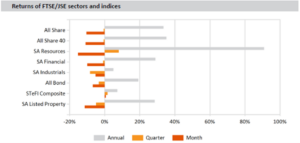
South African equities experienced a sharp drawdown in March as global risk aversion, higher energy prices and a weaker rand weighed on sentiment and equity valuations, particularly in cyclical and resource-linked segments. The FTSE/JSE All Share Index fell 10.5% and the Capped All Share declined 10.6%, pointing to broad-based weakness. Performance across size segments was uniformly negative, with the Mid Cap index declining the most (-11.7%), followed by Large Caps (-10.9%), and Small Caps (-8.2%).
Sector dispersion was notable, with Resources falling the most (-15.2%), while Financials declined 9.7% and Industrials fell 5.2%, consistent with a month in which global growth and inflation uncertainty triggered a broad de-risking move. Within sector groupings, Oil, Gas and Coal rose 21.2%, in line with the spike in global oil prices, while Consumer Services gained 2.9% and Industrial Transportation rose 0.4%. These gains were offset by notable weakness in Industrial Support Services, which fell 11.8%.
JSE performance during March was characterised by sharp stock level dispersion driven primarily by commodity price movements. On the positive side, Sasol was the strongest contributor, with its share price rising 55.1% as it benefited directly from the surge in global oil prices. Coal producers Thungela Resources and Exxaro Resources also gained 51.0% and 13.6% respectively, as higher coal prices supported earnings expectations. In contrast, index performance was weighed down by significant weakness in precious metal producers, with Impala Platinum declining 28.4%, Harmony Gold falling 28.7% and Sibanye Stillwater declining 27.1% as platinum and gold prices retreated sharply. Outside the resources sector, WBHO also detracted from performance after its share price fell 26.6% following earnings disappointment and weaker construction activity.
Local fixed income markets weakened during the month as global bond yields rose and risk premia increased. The All Bond Index declined 6.8%, reflecting pressure across the yield curve. Inflation linked bonds also moved lower, with the Inflation Linked Bond Index falling 5.7%, as higher real yields outweighed inflation protection benefits. Cash remained resilient, with STeFI rising 0.6%. Listed property underperformed significantly, with the All Property Index declining 12.2% amid higher discount rates and weaker risk appetite.
South African inflation data remained subdued in the latest releases, although underlying risks increased as energy prices rose later in the period. Headline consumer price inflation declined to 3.0% year on year in February and increased by 0.4% month on month. Core inflation also eased to 3.0% year on year, indicating limited broad based price pressures at that stage. The decline in inflation was driven largely by transport costs, with fuel prices falling 10.1% year on year, contributing to a 2.1% year on year decline in transport inflation. Food inflation moderated to 3.7% year on year, providing additional disinflationary support. Producer price inflation (PPI) also eased, with PPI declining to 1.8% year on year, supported by lower fuel and food input costs earlier in the period.
Domestic macroeconomic conditions showed modest improvement heading into 2026. Real gross domestic product (GDP) expanded by 0.4% quarter on quarter in the fourth quarter of 2025, supported by a 1.2% increase in household consumption and a 1.3% rise in fixed investment. For 2025 as a whole, economic growth was recorded at 1.1%, representing a gradual recovery from previous years.
The South African Reserve Bank (SARB) maintained the repo rate at 6.75% following a unanimous decision, citing heightened global uncertainty and rising energy prices as key risks to the inflation outlook. Business sentiment improved prior to the escalation in geopolitical tensions, with the RMB/BER Business Confidence Index increasing to 47 in the first quarter of 2026. The overall policy environment remained cautious as authorities balanced moderating domestic inflation against external risks.
Currency markets reflected global dynamics, with the rand weakening 7.54% against the US dollar to R17.12. The depreciation was driven by higher oil prices, capital outflows from emerging markets and a stronger US dollar.
South African Market Indices Performance
About the South African Market Commentary
The retrospective RisCura South African monthly Market Commentary, offers investors insights across key segments including the local markets and economic trends to gain clarity on economic indicators, asset performance, and market dynamics. Geared for informed investors, our insight into emerging markets empowers strategic decision-making in the dynamic South African market.
Subscribe to the South African market commentary by RisCura to understand the economic indicators and factors that affect the economy.
