
South African Market Commentary: January 2026
SA markets gain as resources surge and the rand firms
South African assets posted a positive start to 2026, with equities advancing on broad participation across size segments and strong performance from resource counters. Fixed income also delivered positive returns amid stable monetary policy, with the SARB holding the repo rate unchanged as inflation remained contained within the target range. Improved manufacturing indicators and a firmer rand added support to sentiment, while performance at the stock and sector level reflected a clear tilt toward commodity-linked exposures.
Key highlights:
- SA equities advanced with broad participation.
- Resources led; Industrials lagged.
- Commodity-linked stocks drove many of the biggest moves.
- Bonds and listed property were positive; SARB held steady.
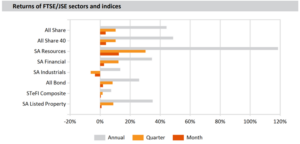
South African equities posted solid gains in January 2026. The FTSE/JSE All Share Index rose 3.7% for the month, while the FTSE/JSE Capped All Share Index increased 3.9%. Performance across size segments was supportive, with mid-caps leading gains at 6.3% for the month, followed by large caps (+4.0%) and small caps (+1.1%). These outcomes were recorded against a backdrop of firmer commodity prices and an appreciating rand.
Sector performance reflected broader market dynamics, with Resources leading decisively, rising 12.5%, amid strong preciousmetal and commodity gains globally. The Financials sector advanced 3.0%, supported by improved risk sentiment and stabilising domestic conditions. In contrast, Industrials declined 3.4%, consistent with weaker performance across several industrial counters as global manufacturing indicators remained mixed.
At the single-stock level, gains were dominated by commodity‑linked counters. South32 led the market with a 30.1% increase, supported by manganese production normalising following earlier operational disruptions and strong multi‑commodity pricing. Sibanye Stillwater rose 22.0% increase, extending gains amid a recovery in PGM markets and continued progress on the capital allocation framework. The third‑strongest performer, Glencore gained 20.6%, benefiting from higher copper prices and renewed interest in its strategic positioning. On the downside, the weakest performer was Sappi, which fell 26.9% amid sustained pressure from weak European paper markets, rising debt levels, and reduced earnings guidance. Richemont declined 14.5% despite reporting higher year‑on‑year sales, as luxury demand conditions and cost pressures weighed on sentiment. Montauk Renewables continued its difficult trajectory declining a further 12.0% amid ongoing profitability pressures linked to lower RIN pricing and earnings deterioration through 2025.
South African fixed income delivered positive returns in January 2026 in an environment of stable monetary policy and contained inflation. The All Bond Index (ALBI) rose 1.9% for the month, while inflation‑linked bonds (CILI) returned 1.3%, and the STeFI Cash Index gained 0.6%. Listed property also participated, with the All Property Index (ALPI) rising 1.1%.
The South African Reserve Bank kept (SARB) the repo rate unchanged at 6.75% following its January 2026 Monetary Policy Committee meeting. The decision followed a split vote, with two members favouring a rate cut, and occurred against a backdrop of improving inflation expectations and global uncertainty. The SARB maintained its assessment that the policy stance remains moderately restrictive while monitoring risks including electricity tariffs, food inflation pressures and global political volatility.
Domestic inflation remained contained within the target range. Headline consumer inflation rose to 3.6% yearonyear in December 2025 from 3.5% in November, while core inflation measured 3.3% yearonyear. Inflation averaged 3.2% for 2025. Housing and utilities inflation measured 4.9%, food and nonalcoholic beverages 4.4%, fuel 0.6%, and electricity 7.9% yearonyear. Meat prices increased 12.6%, cereal prices rose 2.1%, and water tariffs increased 7.0% yearonyear.
Producer inflation also remained moderate, with the Producer Price Index up 2.9% year-on-year in December 2025. Food producer inflation measured 1.7% year-on-year, reflecting improved harvests and slower meat price growth, while other sectors, including mining and electricity, showed mixed price trends.
The manufacturing sector showed early signs of recovery at the start of 2026. The seasonally adjusted Absa Purchasing Managers’ Index rose by 8.2 points to 48.7 in January 2026, following a particularly weak December 2025 reading. The business activity index moved back above the 50-point level and the expected business conditions index measured 66.4. New sales orders improved, with domestic demand offsetting weaker export sales that were affected by the stronger rand.
In currency markets, the rand appreciated 3.2% month-on-month against the US dollar, ending January 2026 at R16.04/USD. Against other major currencies, the rand closed at R22.11/GBP and R19.15/EUR.
South African Market Indices Performance
About the South African Market Commentary
The retrospective RisCura South African monthly Market Commentary, offers investors insights across key segments including the local markets and economic trends to gain clarity on economic indicators, asset performance, and market dynamics. Geared for informed investors, our insight into emerging markets empowers strategic decision-making in the dynamic South African market.
Subscribe to the South African market commentary by RisCura to understand the economic indicators and factors that affect the economy.
