
South African Market Commentary: July 2026
South African markets regain ground as resources strengthen
South African equities returned to positive territory in July as resources, platinum miners and investment conglomerates supported the market. Energy-linked shares benefited from the rebound in oil, while Prosus and Naspers advanced alongside Chinese equities. Telecommunications and gold counters lagged. Bonds weakened as yields moved higher, although listed property remained the strongest local asset class. Inflation pressures broadened across goods and services, while producer inflation eased slightly. The SARB left interest rates unchanged as it balanced persistent price risks against weaker confidence and growth concerns. The rand softened despite broad US dollar weakness, reflecting disappointment over the central bank’s decision.
Key highlights:
- Resource and energy-linked shares led the market as commodity prices strengthened.
- Bonds weakened as yields rose, while listed property continued to provide support.
- The SARB balanced broadening inflation pressures against weaker confidence and growth concerns.
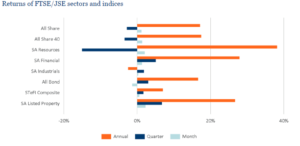
The JSE ended a two-month sell-off in July, with both the All Share Index and the Capped All Share Index rising 1.2%. By market capitalisation, large caps, as measured by the All Share 40 Index, gained 1.4% and the Mid Cap Index rose 1.4%. The Small Cap Index eased 0.4%. In terms of sector performances, Resources led the market, gaining 2.1%, as platinum miners benefited from a 6.2% rise in the platinum price and energy counters followed oil higher. Financials firmed 1.2%, while industrials edged up 0.3%. Investment conglomerates provided significant support, as Naspers and Prosus rallied alongside Chinese equities. Telecommunications was the weakest segment, declining 7.0%.
Among individual stocks, Sasol was the top performer, rising 20% as it followed energy prices higher. Prosus gained 8% on the rally in its largest underlying holding, Tencent, while Glencore also advanced 8%. Platinum miners gained 7% on the firmer platinum price. MTN was the heaviest laggard among the large caps, declining 10%, amid an apparent slowdown in its Nigerian business and ongoing litigation in its Ghanaian division. Gold miners eased 3%.
The ALBI returned -1.4% as bond yields moved higher, with the government’s 10-year borrowing rate increasing by approximately 0.30 percentage points to 8.75%. Inflation-linked bonds, as measured by the CILI, eased 0.2%, while STeFI cash returned 0.6%. Listed property, as measured by the ALPI, was the strongest local asset class, advancing 2.2% and extending its year-to-date gain to 6.9%.
SA headline consumer inflation accelerated for a fourth consecutive month to 5.0% year-on-year in June from 4.5% in May, and rose 0.7% month-on-month. Core inflation, which excludes food, fuel and energy, climbed to 4.1% from 3.8%. The main contributors were transport, which rose 12.7% and added 1.7 percentage points as earlier fuel price increases fed through, and housing and utilities, which increases 5.5% and contributed 1.3 percentage points. Insurance and financial services rose 5.9%, adding a further 0.6 percentage points. Services inflation increased to 5.2% from 4.7%, while goods inflation rose to 4.8% from 4.4%, indicating that price pressures were broadening. The reading remained well above the SARB’s 3% target.
Producer price inflation for final manufactured goods eased to 7.5% year-on-year in June from 7.8% in May, marking its first deceleration since the energy shock began. Prices declined 0.1% month-on-month. The largest contributor remained coke, petroleum, chemical, rubber and plastic products, which rose 22.0% and added 4.7 percentage points. Paper and printed products contributed 0.7 percentage points, while metals, machinery, equipment and computing equipment added 0.5 percentage points. The monthly decline was led by lower petroleum and food prices, although the renewed rise in oil during July may slow further progress.
At its meeting on 23 July, the SARB left the repo rate unchanged at 7%, surprising most analysts who had expected a 25 basis point increase. The decision was a split 4-2 vote, with two members favouring an increase. The committee judged that the policy stance following May’s increase was sufficiently restrictive for the time being and placed greater weight on downside risks to growth, citing fading consumer and business confidence. The SARB lowered its headline inflation forecast for 2026 to 4.0% from 4.4% and raised its growth forecast to 1.4% from 1.2%. Governor Kganyago warned that the renewed conflict in the Middle East, which had lifted oil and fertiliser prices, could still generate second-round effects, leaving the risk of a further interest-rate hike elevated.
The rand weakened 0.9% against the US dollar over the month to close at R16.55 per US dollar. The move ran counter to broad US dollar weakness, with the US dollar index down 1.3%, and followed the SARB’s unexpected decision to leave interest rates unchanged. Against the pound, the rand weakened 2.5% to R22.28, while it declined 1.8% against the euro to R19.06. The rand remained broadly unchanged against the dollar for the year to date.
South African Market Indices Performance
About the South African Market Commentary
The retrospective RisCura South African monthly Market Commentary, offers investors insights across key segments including the local markets and economic trends to gain clarity on economic indicators, asset performance, and market dynamics. Geared for informed investors, our insight into emerging markets empowers strategic decision-making in the dynamic South African market.
Subscribe to the South African market commentary by RisCura to understand the economic indicators and factors that affect the economy.
