Are African equity benchmarks giving investors the wrong picture?
How a benchmark is constructed can materially affect how portfolio performance is understood. New analysis by RisCura shows that benchmark methodology can influence how returns, volatility and risk-adjusted performance are measured across Africa ex-South Africa equity markets.
Drawing on RisCura’s long-term empirical understanding of how African equity portfolios are constructed, managed and reported through changing market conditions, the analysis* compares several widely used Africa ex-South Africa indices. It highlights how differences in benchmark methodology can shape the picture of performance.
Over the period analysed, the realisable methodology outperformed several traditional benchmarks, with the gap widening over time.
What this means for institutional investors is: if the benchmark is misaligned with market realities, the judgement of performance may also be misaligned. Benchmarks are not just reporting tools. They are used to assess whether a portfolio manager has added value, taken appropriate risk, or underperformed. If a benchmark does not reflect the currency, liquidity and repatriation conditions investors actually face, a manager’s performance may be judged against a reference point that is theoretically neat, but practically misleading. The same African equity portfolio could therefore appear to be outperforming, underperforming, or carrying a different level of risk depending on which benchmark is used. In markets where official and realisable exchange rates diverge, or where capital mobility is constrained, the benchmark itself can materially shape the investment story being told.
Benchmarks are meant to provide a neutral reference point for measuring investment decisions,” says George Tsinonis, Head of Investment Analytics at RisCura.
“But when benchmark construction diverges from the conditions investors actually face on the ground, the resulting performance metrics can present a distorted picture.”
Much of this divergence can be traced to how global index providers treat markets experiencing currency dislocations, liquidity constraints or capital mobility challenges. In some cases, markets have been removed from indices entirely when accessibility concerns emerged, even while institutional investors continued managing capital within those markets.
Recent developments across African markets show how these dynamics play out in practice.
In Egypt (2024), the Egyptian pound depreciated by more than 60% in a single day after the Central Bank allowed the currency to float more freely against the US dollar. Investors also faced delays in accessing foreign currency for repatriation.
Nigeria experienced similar distortions between official and parallel exchange rates during 2023 and 2024, with the parallel market premium exceeding 60% at certain points.
Traditional global indices typically rely on official exchange rates, which can differ significantly from the rates investors are able to access when repatriating capital. This can create a disconnect between theoretical benchmark performance and the returns investors are actually able to realise.
Differences in benchmark construction also affect how returns and risk are reflected over time. Analysis covering May 2025 to May 2026 shows that RisCura’s Africa ex-South Africa realisable index methodology, used in RARI, delivered annualised returns of 46.25% at May 2026, while maintaining volatility of about 11.46%. This suggests stronger returns without a corresponding increase in measured risk relative to the traditional benchmarks shown.
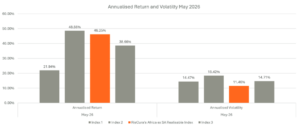
Source: RisCura
The divergence becomes even more pronounced when risk-adjusted returns are examined. Over the last year, the realisable methodology recorded the strongest Sharpe ratio, a metric that measures an investment’s risk-adjusted performance, among the benchmarks shown, at 3.68.
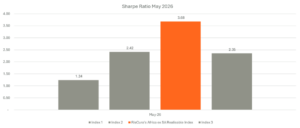
Source: RisCura
When volatility and returns are measured differently across benchmarks, the same portfolio can appear to carry very different levels of risk. That has direct implications for how investment committees interpret manager performance.”
As global investors continue allocating capital to Africa’s emerging and frontier markets, accurate performance measurement is becoming increasingly important. Differences between theoretical benchmarks and realised investment outcomes may become more pronounced in markets where liquidity, currency access and capital mobility remain uneven.
For asset owners and investment committees, the findings highlight the need for a more critical approach to benchmark selection and interpretation, particularly when allocating capital across complex and evolving markets.
Performance discussions should focus on investment decisions and outcomes. But if the benchmark itself is not aligned with real investment conditions, the measurement framework can introduce distortions that are difficult to ignore.”
Ultimately, if benchmarks fail to reflect the realities of investing, they risk measuring assumptions rather than performance.