
South African Market Commentary: June 2026
Commodity reversal weighs on SA resources as domestic sectors hold up
South African markets underperformed in June as weaker commodity prices weighed heavily on resource shares, while domestic-focused sectors proved more resilient. Financials and industrials advanced, supported by the sharp fall in oil and the prospect of consumer relief. Fixed income delivered positive returns as bond yields moved lower, while listed property was the strongest local asset class. Inflation pressures continued to build, with consumer and producer prices reflecting earlier oil and electricity increases. The SARB did not meet during the month, leaving attention on the July policy decision as markets assessed rising inflation against a softer growth backdrop.
Key highlights:
- Resource shares came under pressure as commodity prices reversed sharply.
- Domestic-focused sectors held up better as lower oil prices improved the consumer outlook.
- Bonds and listed property benefited from lower yields and improved sentiment toward rate-sensitive assets.
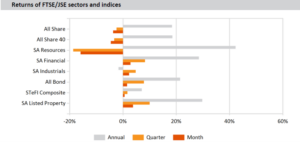
The JSE underperformed in June, with the All Share Index falling 3.7% and the Capped All Share Index also down 3.7%. In terms of market capitalisation, large caps (as measured by the All Share 40), fell 4.5% and mid-caps eased 2.1%, while small caps gained 2.3%. At a sector level, resources were by far the weakest segment, down 15.9%, as precious metals counters slumped on the unwinding of geopolitical risk premiums and falling commodity prices. In contrast, domestic-focused sectors firmed, with financials up 2.6% and industrials up 2.2%, supported by the sharp fall in oil and the prospect of consumer relief.
In terms of individual stock counters, the top performers were Datatec (+20.2%) following a special dividend and strong results, Italtile (+19.8%), and Super Group (+16.6%), as domestic retailers rallied on the oil-price collapse and expected consumer relief. The heaviest laggards were thermal coal exporter Thungela Resources (-35.8%) as the coal risk premium unwound, Pan African Resources (-29.1%), and Sibanye Stillwater (-28.6%), as precious metals prices fell sharply.
In fixed income, The ALBI returned 1.6% as bond yields moved lower. Inflation-linked bonds, as measured by the CILI, gained 1.5%, while STeFI cash returned 0.6%. Listed property, as measured by the ALPI, was the strongest local asset class, advancing 3.8% as the fall in oil and an improved consumer outlook lifted rate-sensitive counters.
SA headline consumer inflation rose for a third month to 4.5% year-on-year in May from 4.0% in April, the highest reading since July 2024, and increased 0.7% month-on-month. Core inflation, which excludes food and fuel, climbed to 3.8% from 3.6%, its highest level in about 18 months. The main contributors were transport, up 9.4% from 4.9% as earlier fuel-price increases fed through, and housing and utilities, up 5.3% and lifted by Eskom’s tariff hike. Restaurants and hotels rose 5.8% from 5.2%, while food inflation eased to 1.9% from 2.9%.
Producer price inflation for final manufactured goods jumped to 7.8% year-on-year in May from 4.8% in April and rose 2.6% month-on-month. The largest contributor was coke, petroleum, chemical, rubber and plastic products, which rose 22.0% and added 4.7 percentage points, as diesel prices surged 66.7% and petrol rose 28.1% year-on-year. Paper and printed products added 0.7 of a percentage point, while food, beverages and tobacco products added 0.6 of a percentage point. The sharp rise reflects the peak pass-through of the oil shock, which is expected to ease as fuel prices fall.
The SARB did not hold a policy meeting in June. The repo rate remained at 7% following the 25-basis point hike at the May meeting, its first increase since 2023. With headline inflation still climbing and producer inflation surging, attention turns to the July meeting, where the committee must weigh rising near-term inflation against a softening growth outlook.
The economy grew 0.5% quarter-on-quarter in the first quarter, up from 0.4% in the fourth quarter and ahead of the 0.3% expected by the market. This marked a sixth consecutive quarter of expansion and the strongest pace since the second quarter of 2025. Growth was broad-based, with nine of the 10 industries expanding, led by finance, real estate and business services, which grew 0.9% and was the largest contributor, followed by agriculture, up 3.9%. Manufacturing was the main drag, contracting 0.8%. On the demand side, net exports added 0.9 of a percentage point as exports rose and imports fell, although fixed investment declined 1.1%. Annual growth accelerated to 1.9% from 0.8% in the prior quarter, pointing to firmer momentum entering 2026. The current account swung to a surplus of 2.4% of GDP from 0.6% in the fourth quarter, the widest since early 2022, on a stronger trade surplus. However, the Absa Purchasing Managers’ Index fell back below the neutral 50 mark to 47.3 in June from 50.8 in May, as new orders weakened.
The rand weakened 1.2% against the US dollar over the month to close at R16.39 per US dollar, pressured by the fall in precious metals prices and a firmer dollar. Against the pound and euro, however, the rand strengthened 0.5% and 1.1% respectively, closing at R21.73 and R18.72. The rand has firmed roughly 1.1% against the dollar for the year to date.
South African Market Indices Performance
About the South African Market Commentary
The retrospective RisCura South African monthly Market Commentary, offers investors insights across key segments including the local markets and economic trends to gain clarity on economic indicators, asset performance, and market dynamics. Geared for informed investors, our insight into emerging markets empowers strategic decision-making in the dynamic South African market.
Subscribe to the South African market commentary by RisCura to understand the economic indicators and factors that affect the economy.
