
South African Market Commentary: February 2026
SA rides the risk-on rotation as resources lead and fiscal credibility improves
South African equities participated fully in February’s global risk-on rotation, with broad-based gains and standout performance from resource counters supported by stronger precious-metal pricing and improving cash flow dynamics. Local fixed income and listed property also delivered positive returns as inflation stayed contained and fiscal metrics improved, while the Budget Speech reinforced a commitment to gradual fiscal consolidation. The rand ended firmer on the back of the rally in precious metals and an improved fiscal stance.
Key highlights:
- South African assets strengthened on a broad-based risk-on rally, led by resource counters and supported by improved sentiment.
- Bonds and listed property gained as inflation remained contained and fiscal credibility improved following a market-friendly Budget Speech.
- The rand firmed as precious metals rallied and the fiscal backdrop stabilised.
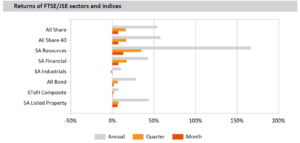
South African equities participated fully in the global risk-on rotation in February, with broad-based gains across the domestic market and particularly strong performance in resource counters. The FTSE/JSE All Share Index rose 7.0% in February, while the FTSE/JSE Capped All Share Index advanced 7.2%. By size segment, large caps delivered the strongest return at 7.2%, whilst mid-caps gained 5.4% and small-caps 5.3%, indicating that the rally extended beyond the largest constituents into the broader opportunity set.
Sector performance was clearly led by resources which rose 13.3%, supported by elevated prices for gold and platinum-group metals, as well as improving free cash flow generation among diversified miners. Financials also delivered solid returns, gaining 7.3%, reflecting resilient earnings momentum in the banking sector and gradually improving credit conditions. Industrials were broadly flat, rising just 0.1%.
Stock-level dispersion remained elevated, driven by strong gains in resource and cyclical shares. Pan African Resources rose 31.9% and AngloGold Ashanti gained 30.3% on robust earnings growth, higher production and strong cash flow, supported by elevated gold prices. Sasol advanced 27.2% despite weak earnings, as investors focused on improved cash flow and deleveraging amid firmer oil prices. On the downside, SPAR fell 21.3% and Pick n Pay declined 19.2% following trading updates that pointed to weak revenue growth and margin pressure in a highly competitive retail environment.
Local fixed income delivered positive returns in February, supported by contained inflation, improving fiscal metrics and global demand for yield. The All Bond Index gained 1.7%, while inflation-linked bonds outperformed, rising 3.5% amid moderating inflation, and confirmation of a peak in the debt ratio. Cash returns remained steady, with STeFI up 0.5%. Listed property also rallied, with the ALPI rising 6.6% for the month and 7.3% year to date, aided by lower yields, a stabilising growth outlook, and a firmer rand.
Headline CPI eased to 3.5% year-on-year in January 2026 from 3.6% in December, with a monthly increase of 0.2%, keeping inflation comfortably within the South African Reserve Bank’s 3% target and its 1 percentage point tolerance band. Core inflation, which excludes food, non-alcoholic beverages, fuel and energy, edged up modestly to 3.4% year-on-year in January 2026 from 3.3% in December, indicating only gradual underlying pressure from services, rents and administered prices. Food inflation remained steady at 4.4%, as elevated meat prices, up 13.5% year-on-year and driven by foot-and-mouth-related supply constraints, were offset by declines in fruit, vegetables, oils and dairy following favourable harvests. Transport inflation fell 0.2% year-on-year as fuel prices fell 3.7% on lower global oil prices and a firmer rand, providing meaningful relief to households and businesses.
On the production side, producer price inflation for final manufactured goods fell to 2.2% year-on-year in January 2026 from 2.9% in December, a five-month low, as fuel-related components declined 4.1% and food-product PPI slowed to 0.8%, signalling limited pipeline pressure on consumer prices in the near term.
In his 2026/27 Budget Speech, Finance Minister Enoch Godongwana delivered a measured and broadly market-friendly fiscal update against a backdrop of firmer commodity prices and improved revenue performance. The budget reinforced government’s commitment to gradual fiscal consolidation, supported by a commodity-driven revenue overrun of R21.3 billion that provided short-term breathing room without the need for major tax increases. The consolidated deficit is projected to narrow from 4.5% of GDP to 3.1% by FY29, while gross debt is expected to peak at 78.9% of GDP in FY26 before easing gradually over the medium term.
Revenue strength was largely driven by higher VAT and corporate taxes linked to firm commodity prices, while expenditure growth remained contained and increasingly focused on infrastructure and growth-enhancing investment. Modest personal income tax relief was granted through inflationary bracket adjustments, but fuel levies and excise duties were increased. Overall, the budget signals improved fiscal credibility and stabilising debt dynamics, although sustainability remains contingent on continued expenditure restraint, structural reform execution, and a supportive global commodity backdrop.
In foreign exchange, the rand appreciated by around 0.8% against the US dollar over the month, with the ZAR/USD rate ending February at R15.92/USD, supported by the rally in precious metals and an improved fiscal stance.
South African Market Indices Performance
About the South African Market Commentary
The retrospective RisCura South African monthly Market Commentary, offers investors insights across key segments including the local markets and economic trends to gain clarity on economic indicators, asset performance, and market dynamics. Geared for informed investors, our insight into emerging markets empowers strategic decision-making in the dynamic South African market.
Subscribe to the South African market commentary by RisCura to understand the economic indicators and factors that affect the economy.
